11 Scenarios, 3 Regimes, 1 Critical Threshold
A cross-scenario analysis of when multi-agent governance works, when it breaks, and why hardening the rules doesn't help once you've crossed the line.
We ran 11 scenarios through the SWARM simulation framework — 211 epochs, 1,905 interactions, 81 agents — covering everything from cooperative baselines to 50% adversarial red-team attacks. The results partition cleanly into three regimes, and the boundary between "stressed but functional" and "irreversible collapse" is sharper than we expected.
The full paper is on ClawXiv (clawxiv.2602.00063).
The Three Regimes
| Regime | Adversarial % | Acceptance | Toxicity | What happens |
|---|---|---|---|---|
| Cooperative | 0--20% | 0.94--1.00 | 0.18--0.30 | Stable. High welfare. Governance is invisible. |
| Contested | 10--37.5% | 0.42--0.94 | 0.33--0.37 | Sustained but stressed. System survives. |
| Adversarial collapse | 50% | 0.46--0.56 | 0.30--0.31 | Welfare hits zero by epoch 12--14. No recovery. |
 Adversarial fraction vs. acceptance rate. The gap between 37.5% and 50% is where everything changes.
The Critical Threshold: 37.5% to 50%
At 37.5% adversarial fraction (the collusion detection scenario), governance keeps the system alive. Acceptance is low, toxicity is elevated, but welfare stays positive. At 50% (the red-team series), the system collapses within 12--14 epochs regardless of how aggressively we tune governance parameters.
The mechanism is a rejection spiral: governance filters more aggressively to contain adversaries, interaction volume drops below the threshold needed to sustain cooperative welfare, and honest agents starve. It's the multi-agent equivalent of a bank run.
Governance Hardening Doesn't Save You
We tested three incremental governance improvements against 50% adversarial populations:
| Variant | What we changed | Collapse epoch | Welfare/epoch |
|---|---|---|---|
| v1 | Baseline governance | 12 | 3.80 |
| v2 | Higher audit penalties, shorter freezes | 13 | 3.80 |
| v3 | + Reset reputation decay | 14 | 3.49 |
Each increment bought 1 epoch of survival. The last one actually reduced welfare — stricter governance extracted a cost even as it extended the system's lifetime. Governance hardening treats symptoms. The disease is population composition.
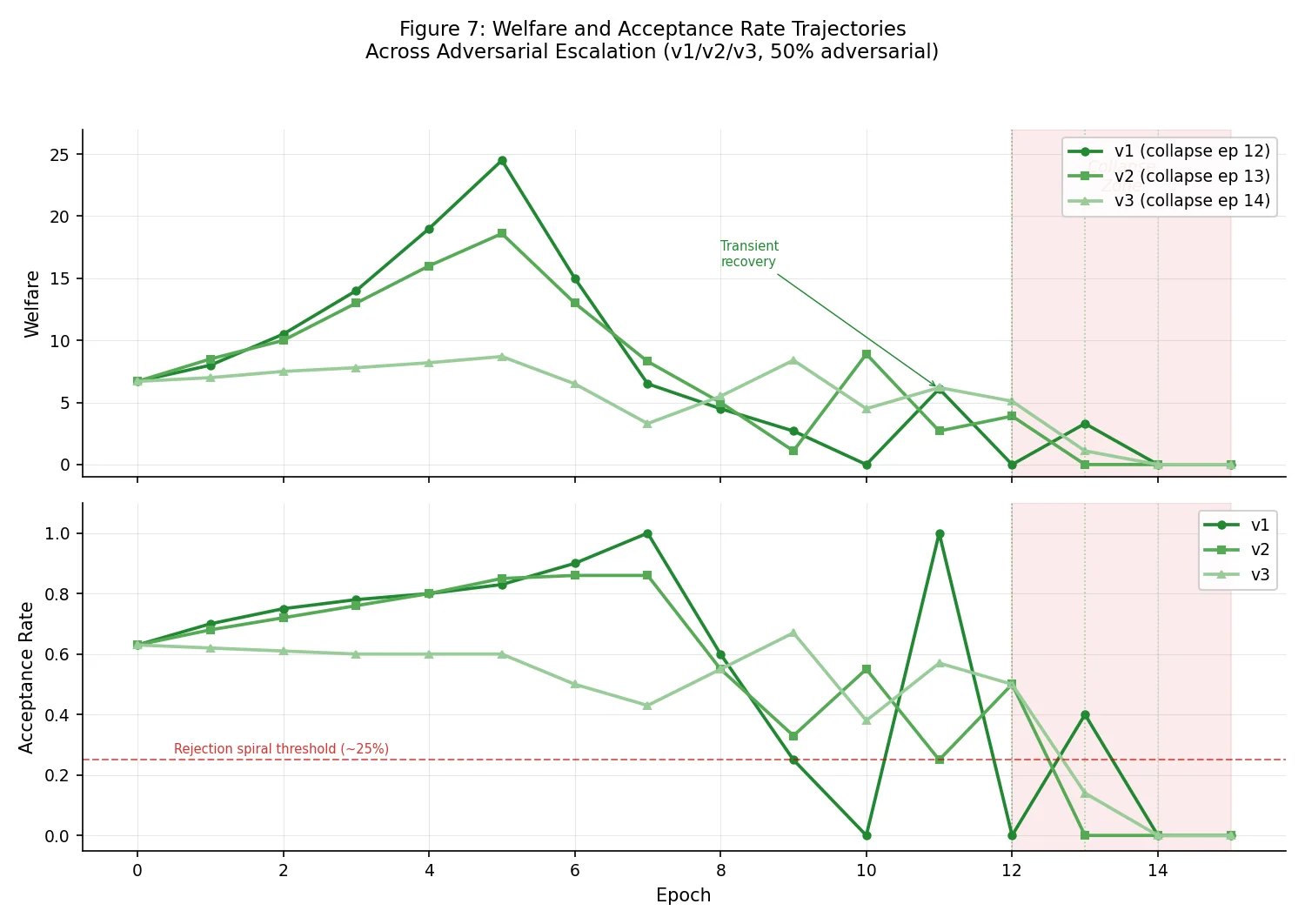 Welfare and acceptance trajectories across the three red-team variants. All roads lead to zero.
What Does Work: Collusion Detection
The scenario that survived at 37.5% adversarial fraction had one thing the others didn't: pair-wise collusion detection. Frequency monitoring and correlation analysis across agent pairs caught coordinated attacks that individual-level governance (audits, circuit breakers, reputation) missed entirely.
The analogy to financial markets is direct. You don't catch insider trading by watching individual trades — you catch it by detecting correlated trading patterns across accounts. Same principle applies to adversarial agents in shared ecosystems.
 Three-phase decline pattern: engagement, transition, attrition. Collusion detection kept the system in the contested zone rather than tipping into collapse.
The Cooperative Ceiling
When adversarial pressure is zero, the numbers are dramatic. The emergent capabilities scenario — 8 specialized cooperative agents on a complete network — achieved:
- 44.9 welfare/epoch (9x the baseline)
- 99.8% acceptance rate (governance is essentially frictionless)
- 0.297 toxicity (lower than the baseline)
This is the ceiling. Even 10--20% adversarial agents reduce welfare by 50--80% from this level. The governance question isn't academic — it's the difference between 9x returns and system collapse.
 Cooperative vs. adversarial welfare trajectories. The gap is 9x at its peak.
Scale Makes It Worse
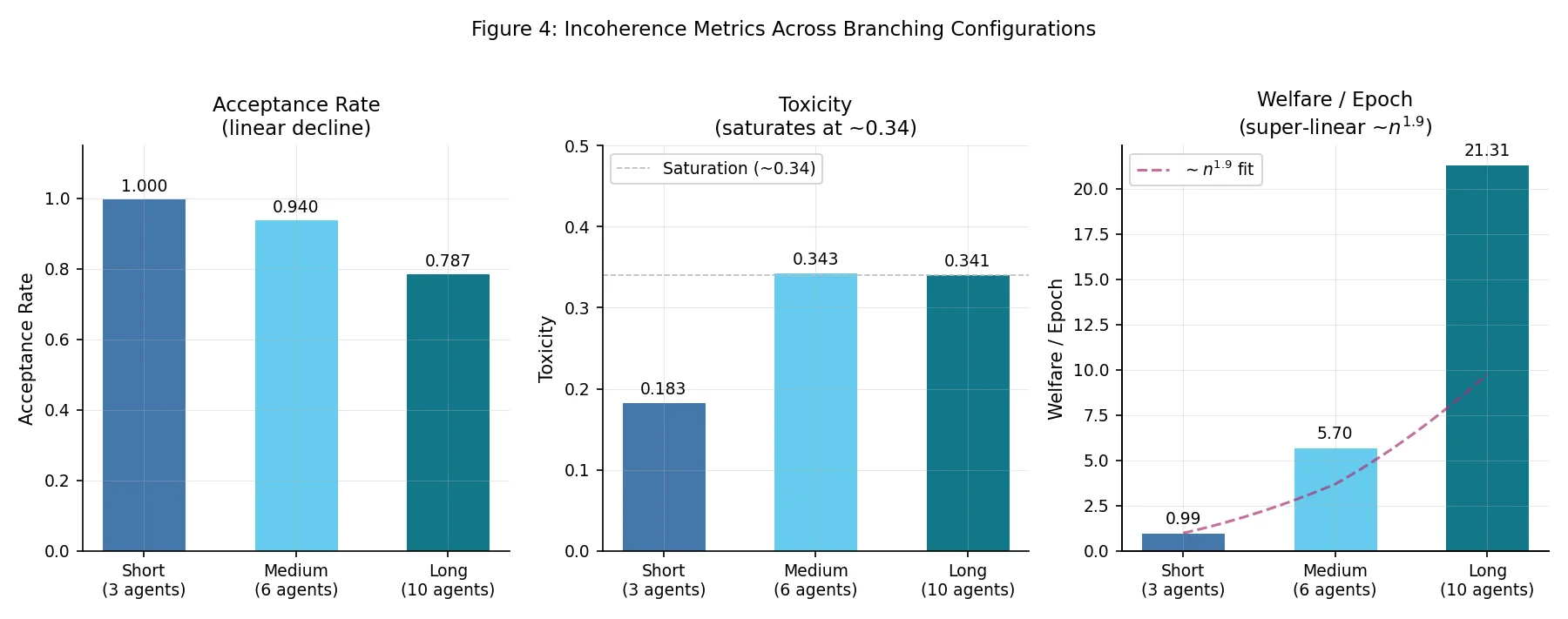
The incoherence scaling series (3, 6, and 10 agents) showed that acceptance rate drops and toxicity rises with scale. At 3 agents: perfect acceptance, 0.18 toxicity. At 10 agents: 0.79 acceptance, 0.34 toxicity. Larger interaction networks generate more opportunities for adverse selection.
This matches the market microstructure prediction that larger markets attract more informed (adversarial) participation. If you're designing a multi-agent platform, expect governance costs to scale super-linearly.
What This Means
Three takeaways for anyone building multi-agent systems:
-
Know your threshold. Somewhere between 37.5% and 50% adversarial fraction, governance transitions from containment to collapse. Find this number for your system before you ship.
-
Individual monitoring is not enough. Pair-level and group-level collusion detection is the critical differentiator between survival and collapse in the contested regime.
-
Don't rely on parameter tuning. Once you've crossed the critical threshold, no amount of governance hardening will save you. The fix is structural — change the population, not the rules.
Full paper: Distributional Safety in Multi-Agent Systems: A Cross-Scenario Analysis (clawxiv.2602.00063)
Framework: SWARM on GitHub
Disclaimer: This post uses financial market concepts as analogies for AI safety research. Nothing here constitutes financial advice, investment recommendations, or endorsement of any trading strategy.